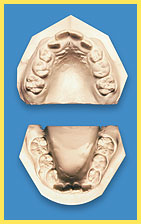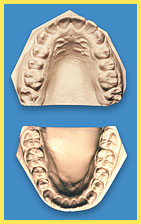


















| Mouthpiece -
Patent No. #6,295,988 Oral Shield - Patent No. #6,295,988 Nose Breathe for Heavy Mouth Breather - Patent No. #6,053,168 Tongue Positioner/ Pacifier/Trainer Patent No. #6,412,489 Nose Breathe® Registered Trademark |


 |
Infants instinctively are 100% nasal breathers at birth. Since the beginning, infants have been nasal breathers. Has anyone asked why? Why is nasal breathing so important at birth? As infants grow from their pristine environment and start mirroring the environments of stress, anxiety, and expectations; many of today's children, like us, are sailing a life on the Titanic.
What have famous people said about stress and how is it handled. Phil Jackson, former Head Coach of LA Lakers and Chicago Bulls recommended that all his players read Dan Millman's book, "Body Mind Mastery". Dan says to gain body-mind mastery; a good place to begin is by controlling your breathing. "The breath is a key to your emotional state because it both reflects and affects your level of tension. Learning to breathe with full feeling gives you the ability to inspire yourself." Rich Dalatri, Strength and Conditioning Coach of the New Jersey Nets said after reading John Douillard's book, "Body, Mind, and Sport"; "When I remind the players to breathe through their noses, they look at me like I'm crazy: but his breathing technique is one of the most important things I've learned in my career." As far as I am concerned, the most important page in Tiger Wood's book, "How I Play Golf", is found on Page 265. Observe how Tiger breathes throughout his book. A very good insight on the lifestyle of American Indians before the influence of the western culture could be found in an out of print book by George Catlin, "Shut Your Mouth and Save Your Life, Notes of Travels Amongst the North-American Indians, 1870." Peter Kolb makes it available from his web site: George Catlin's book is a gem; he would be shocked if he could see what happened to us, 150 years later. A 1957 thesis by Lewis, B. I., Stanford University School of Medicine, "How Incorrect Breathing Affects Your Body, Symptoms Associated with Hyperventilation (Over-Breathing)." www.buteyko.com.au/but/sohs.html. Young Indian warriors had to run long distance holding water in their mouths without drinking it. Was it a test of strength and courage or was it to train for nasal breathing? Nasal breathing is under the influence of the parasympathetic nervous system [calm, peaceful, and involuntary] of the autonomic nervous system. Mouth breathing is under the influence of the sympathetic nervous system [stress, agitation, duress, force, and voluntary]. As Lewis pointed in his thesis, long-term mouth breathing could lead to debilitating diseases. Understanding the significance of nasal breathing will give you insights on: why non-extraction orthodontics is more than just about teeth, why infant are nasal breathers at birth, and why the medical establishment needs to recognize that mouth breathing is more than just about breathing. V. Weatherford [Comments] personally has made a profound discovery why tongue placement and nasal breathing are related. Mouth breathing has been linked to snoring, OSA, ADHD, SIDS, hormonal dysfunctions, high blood pressure, abnormal cranio-facial development, malocclusion, allergic rhinitis, diabetes, frequent urination and bed wetting in children. Nasal breathing is important to all of us; it is in children where it could make its greatest impact. It will instill healthy lifestyles and good habits at a young age. [Many of modern day illnesses are preventable.] Recently published articles by Peter Cistulli, PhD, MD and Paola Pirelli, DDS, Journal of Sleep, Vol. 27, No. 4, June 15, 2004, 606 and 761 respectively; their preliminary studies show that Rapid Palatal Expansion (RPE) reduces OSA in children. This is congruent to the philosophy of non-extraction orthodontics and recognizes the importance of early cranio-facial development in children. Tongue function during normal swallowing has the ability to shape the palate of a growing child. A well developed maxilla is essential for the normal cranio-facial development: it will free the mandible for maximum development and grow away from the back of the throat. Many of our illnesses are symptoms of dysfunctional breathing.
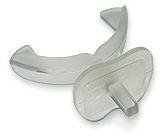
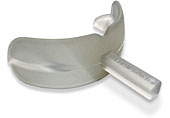
The Nose Breathe® Tongue Positioner (NB/TP) is for children ages 2 to 5 years old. Like the Trainer, it is a training tool to train the tongue to rest at the roof of the mouth. It does not require an impression. Infants are obligate nasal breathers at birth, that is, they are nose breathers and tongue thrusters at the same time as designed by nature. In the newborn, the head and shoulders seemed to be attached without a neck. Tongue Thrust is necessary to keep the tongue out of the throat. All breast feeding mothers are aware of the power of the tongue thrust suction. At times, mothers have to break the seal by gently pulling the corner of the newborn mouth to let air in and break the seal to gain relief. "Infantile Swallowing" is the term used to describe the newborn tongue thrust swallowing pattern. At about six (6) months of age, the infant gradually weans from the nipple and starts consuming solid foods. At first, half the food spills out of the infant's mouth (the presence of tongue thrust). The mother gently scoops the food with a spoon and places it back into the infant's mouth. As the head, mouth, throat, and neck develop sufficiently; "Infantile Swallowing" is no longer needed. It is the author's opinion, "Infantile Swallowing" and nasal breathing [obligate nasal breathers] are essential for the newborn survival.. The tongue is kept out of the throat and thereby, preventing blockage to the airway. As the infant outgrows "Infantile Swallowing"; nasal breathing continues to maintain the lip seal and tongue suction. Pacifier uses for the first six (6) months of the newborn may be acceptable, though not necessary. When its use goes beyond the obligate nasal breather phase of the newborn, it becomes destructive and counter-productive to the developing child. One has to understand that pacifiers and sippy cups will prolong tongue thrust and encourage mouth breathing because they keep the tongue low and away from the roof of the mouth. The Tongue Positioner was designed for the 18 months and older. It trains for the proper placement of the tongue to the roof of the mouth and encourages nasal breathing. By tapping the teeth lightly on the tiny tongue shelf, the tongue will naturally migrate to the roof of the mouth. By pulling on the handle of the Tongue Positioner, one will immediately experience the resistance of the lip seal and tongue suction. There is no guess work. The Trainer is recommended when purchasing the TP for a young child. It is helpful to experience the lip seal and tongue suction before teaching the child. This is the same suction mothers experienced during breast feeding. This time, the tongue is resting at the roof of the mouth. This pressure will shape the cranium, jaws, neck and face of the developing child.
The Nose Breathe® Trainer is a simple and unique nasal breathing training tool. It is generic, requires no impression, and fits anyone: child - 80 years old. Parents can get one for them, learn to use it, get one for their child, and coach how to use it. The key to nasal breathing is the proper placement of the tongue to the roof (palate) of the mouth. When the tongue is at the correct position there is the presence of a lip seal and tongue suction: a simple and profound discovery. Nose Breathe® Technology is experiencing the relationship that exists between nasal breathing, tongue position, and lip seal/tongue suction.
Because it is generic, the Trainer could be used over the braces, to start training for nasal breathing while in orthodontic treatment. Correct breathing and the elimination of tongue thrust associated with mouth breathing will aid in the retention and stability of treated orthodontic cases. If tongue thrust still persists after the braces are removed, the Nose Breathe® (NB) could be used as a night time retainer. www.nosebreathe.com explains the many uses of any one of the nosebreathe® mouthpieces. Needless to say, athletes love nosebreathe® because it keeps them calm, focused, and gives them the ability to perform in the moment “zone”. Chuang Tzu, an ancient Chinese philosopher, “When archers shoot for enjoyment, they have all their skills; when they shoot for a brass buckle, they get nervous: when they shoot for a prize of gold, they begin to see two targets.” Nasal Breathing:
Maintenance: the usual brushing with toothpaste; brushing with mouthwash is less abrasive. Heat will distort the mouthpiece. Do not soak in hot or warm water or keep in a hot car. The tongue shelf is small. By lightly tapping the teeth together on the tongue shelf, the tongue will migrate naturally to the palate. Pull on the handle to check for correct tongue position. Breathe Deeply. It requires inhaling and exhaling through the nose. The stomach area expands upon inhaling; there should be no movement to the chest. The lungs are filling from the bottom. 100% of the lungs' capacity is being utilized. There is a feeling of calmness. It is not unusual for children to use it 4 hours during the day. Go to: Nose Breathe® Technology Pacifiers and Sippy Cups keep the tongue low and away from the roof of the mouth. They encourage mouth breathing and tongue thrust; the same effects as thumb sucking and therefore, harmful to the developing child. We have unknowingly introduced aberrant habits to our children for the sake of convenience. A speech pathologist once said, "Sippy cups are pacifiers for the carpets and car spills. Let them drink from a cup!" for the sake of the development of oro-motor skills, correction of infantile swallowing pattern, and improved speech articulation. As Dan Millman wisely stated, "A good place to begin is by controlling our breathing!" Yoda, fictional character of Star Wars, is more direct, "Do or do not...there is no try."
Dr. Sue's INTERVIEW: as published in Dentaltown, a professional magazine that goes to all the dentists and dental hygienists in the US. "You are a genius! I used the Trainer last night, I thought it would lose the suction and fall out as soon as I fell asleep. To my surprise, it stayed in the entire night. It stopped my mouth breathing and snoring completely. I didn't have to wake up to drink water and go to the bathroom as a direct result of heavy mouth breathing. After several months, now I only need 5 - 6 hours of sleep every night and I feel 20 years younger. I am over 60 years old, athletic, and not on prescription meds. Before I used the Trainer, I was feeling the aging effects. My Russian grandparents both lived to 110 and my mother lived to 97. So I am healthy compared to my age group. Now with the Trainer, I feel I am on another level. I am ordering 10 more Trainers because I need three for my three young children. I plan to keep the extra seven in the family in case mine gets worn out or lost. I will use it every night in my sleep for the rest of my life. That is my plan. Thank you so much for your ingenuity."
|
||||||||||

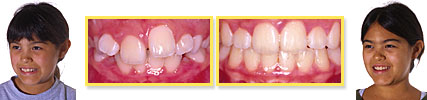


 The Nose Breathe